

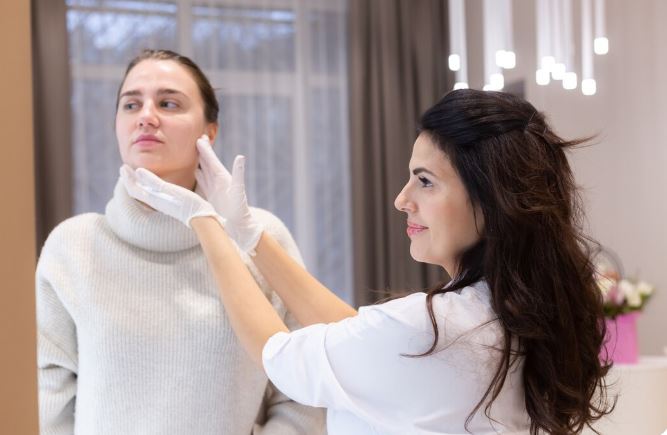
In the waiting area, she didn’t cry. Her laser technician can still clearly recall that particular detail. The majority of customers fidget, browse through their phones, and strike up a conversation about parking or the weather. This one sat with her hands folded in her lap and her coat still buttoned, gazing off into the distance with the unique stillness of someone who has just completed a huge task. The client stated, almost casually, that she had finalized her divorce that morning when the technician called her name and they entered the treatment room. She went on to say that she had finally made the reservation after wanting to do so for two years. She closed her eyes and reclined on the treatment table. The appointment went according to plan.
There is a version of this story that is simple to write off as superficial: a woman who confuses emotional processing with self-improvement and uses a cosmetic procedure to mark a legal milestone. However, practitioners in aesthetic medicine and laser clinics hear variations of it frequently enough to know it’s more complicated than that. A routine session crammed between a dentist appointment and a school run is not the same as appointments made in the wake of a separation, a layoff, a death, or a big birthday. The treatment itself is practically incidental to something else that is taking place in the room.
Among cosmetic procedures, laser hair removal is particularly intentional. It’s not the immediate satisfaction of a new haircut or the immediate outcome of a facial. A complete course entails six to eight sessions spaced four to six weeks apart, requiring the client to follow through for several months. Between appointments, the skin must be kept in a specific condition—it cannot be exposed to the sun, tanned, or waxed. It requires perseverance and consistency. This may be the exact reason it appeals to women who are navigating the specific type of identity void that arises after a long marriage ends. It’s not because it quickly yields dramatic results, but rather because it necessitates consistent, long-term self-reliance.
Divorce often leaves a particular kind of disorientation in its wake, not only grief but also an odd formlessness around routines and daily habits that were previously structured around someone else. Research indicates that small, intentional acts of self-care can help rebuild that structure in ways that feel truly chosen rather than inherited. Psychologists who work with people through separation describe it as a loss of the scaffolding that structures everyday life. The most accessible location for this type of reclaiming is the body. It is made of concrete. You own it. Subtly, the six future dates on the appointment card represent a plan for the coming months, one that you have created specifically for yourself.
It’s important to acknowledge that the beauty industry isn’t totally impartial in this situation. Clinics and practitioners are aware of the emotional burden these appointments carry, and their marketing frequently uses phrases like “new chapter” and “fresh start” that make sense commercially. It’s worth noting, but it doesn’t lessen the genuineness of the impulse behind the reservation. On the day of her divorce, the woman at the treatment table isn’t being sold something she doesn’t want. She’s making a decision that she’s been putting off for years, maybe because the money or time was always going somewhere else first, maybe because she needed to fully own herself before she could spend either on something for herself.
Sitting in the treatment room with her client’s almost cheerful composure, the laser technician found herself thinking about that final section. That morning, the divorce had not taken place. The legal documents did not reflect how long it had been going on. The paperwork caught up that morning. The previous day, the reservation was made. It turns out that some decisions don’t really need to start with an appointment. All they need to do is be prepared to attend at last.
