

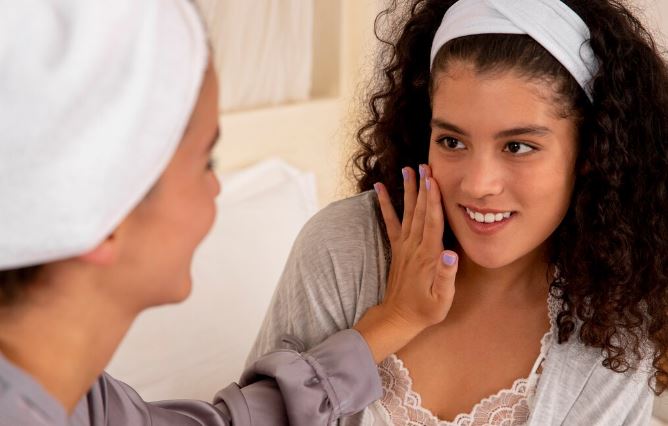
Across the nation, a certain type of well-meaning error occurs in car rides and kitchens almost daily. When a parent notices their teen’s breakouts, they go to the pharmacy, get an acne wash with a large label, leave it on the bathroom counter without saying anything, and sincerely think they’ve helped. The adolescent discovers it. interprets it as a decision. Furthermore, the conversation that never took place causes more harm than the one that ought to have.
Before giving any advice on how to do it better, it’s important to acknowledge that talking to teenagers about skin is actually challenging. In ways that most adults have conveniently forgotten, physical insecurity is layered on top of social pressure during adolescence. When you include TikTok, which has turned close-up skin examination into a distinct genre of content, the anxiety that many teenagers already have about their skin tone is substantial before a parent even speaks. The way that the next event is framed is crucial. Even the most useful advice can be interpreted as criticism if you approach it incorrectly. If you approach it correctly, a teenager may be able to carry on the same conversation.
The urge to fix is the first instinct to be resisted. Dermatologists and child psychologists generally concur that the conversation should begin with a question before recommending a product or mentioning an appointment with a dermatologist. How do you feel about your skin? Are you bothered by it? What have you been utilizing? These aren’t deflections; rather than making assumptions about a teenager, they’re a way for parents to find out where they truly stand. Some teenagers are secretly upset about their skin and in need of assistance but are unsure of how to ask for it. Others would consider an uninvited tutorial to be patronizing since they have it more or less under control. The only way to tell the difference is to ask first.
More than most parents realize, language is important. Words like “dirty,” “bad,” or even something as mild as “problem skin” have weight that is difficult to shake. Shame can be avoided by redefining breakouts as a biological process, which is what they are, rather than a personal shortcoming. It’s not lecturing to explain that sebum, the skin’s natural oil, becomes problematic when it hardens inside pores and fosters an environment for bacteria; rather, it’s helpful information given without passing judgment. It becomes concrete rather than abstract when it is placed in a physical context, such as “it’s similar to what happens when you don’t shower after football,” and it doesn’t imply that the teenager did anything wrong.
When the time comes, the product discussion should be cooperative rather than dictatorial. Rather than coming home with a bag of solutions, there is a compelling argument for going shopping together. It shows respect for the adolescent’s right to control their own appearance, which is important at a time when autonomy is being fought for in every other situation. A mild cleanser, a light, non-comedogenic moisturizer, and a daily SPF cover what most teenage skin actually needs, so the routine itself doesn’t need to be complicated. The more crucial message is what not to use: adult anti-aging treatments, retinol, and strong peeling acids are becoming more prevalent on social media and are actually unsuitable for younger skin because they can harm a developing skin barrier. It is more likely to be accepted as a fact than as a prohibition if it is stated calmly.
It’s difficult to ignore how much of this advice revolves around one issue: how parents handle their own emotions. Teens take in far more information than they reveal, and parents who make disparaging remarks about their own faces, such as pointing out lines in the mirror or brushing off their own skin tone, send a message that sticks. The most lasting thing a parent can do is probably to model genuine comfort with normal skin or indifference to small flaws. The formal dialogue is important. Whether intentional or not, the ambient one is equally important and occurs constantly.
