

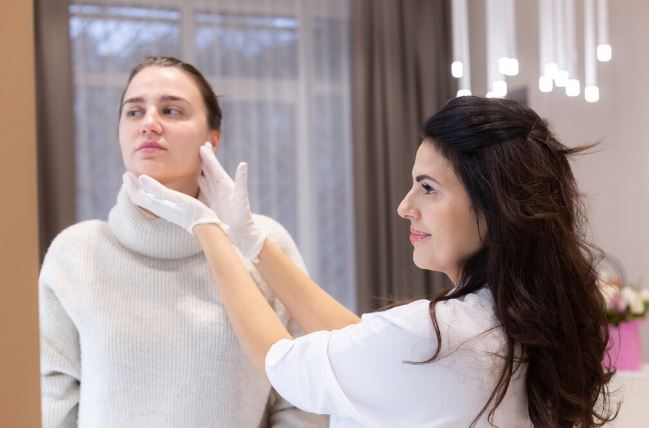
After that, the treatment room was silent. The machine was humming down to standby mode, clean towels were folded on the trolley, and the subtle aroma of something botanical persisted. A client with red eyes, not from the procedure but from crying, was sitting up slowly on the treatment bed and blinking at her reflection in the tiny mirror. Everything had been done correctly by the aesthetician. The equipment was authentic, the technique was sound, and the protocol was adhered to. Nevertheless, tears were shed.
It’s the kind of moment that isn’t included in treatment menus or product brochures. However, those who have worked in the skincare industry long enough will be aware of it, as it occurs more frequently than the industry usually admits. When a client arrives with one expectation and departs with another, something emotionally significant happens somewhere in the space between the two. More crucial than any serum currently available on the market is probably understanding why that occurs and what it reveals about the relationship between skin and self.
| Detail | Information |
|---|---|
| Treatment Name | HydraFacial |
| Type | Non-invasive, multi-step facial treatment |
| Process Steps | Cleanse & exfoliate, gentle acid peel, vacuum extraction, hydration infusion |
| Key Ingredients | Hyaluronic acid, peptides, antioxidants, glycolic acid, salicylic acid |
| Typical Session Length | 30–60 minutes |
| Expected Result | Instant glow, smoother texture, reduced congestion |
| Common Side Effects | Redness, tightness, mild sensitivity — typically resolving within 24–72 hours |
| Who It Suits | All skin types, including sensitive and acne-prone |
| Sessions Required | Monthly for maintenance; results build with consistency |
| Emotional Risk Factor | Unmet expectations, unaddressed sensitivity, poor pre-treatment communication |
| Reference | Harley Street Skin Clinic – Hidden HydraFacial Side Effects |
According to reports, a HydraFacial is performed every 56 seconds worldwide, making it one of the most common facial procedures. Deep cleansing, mild exfoliation, pore extraction, and hydration infusion—all in a single session with no downtime—are the compelling promises that underpin its reputation. The last line, “no downtime,” is where the complexity lies. It’s true for the majority of people. Within hours, the redness goes away, the skin appears fresh and dewy, and clients return to daylight looking better than when they first arrived. However, the experience appears differently for some people, especially those with weakened skin barriers, complexions prone to rosacea, or increased sensitivity. Congestion-clearing suction may seem excessive. When the barrier is thin, the brightening acids can sting. Instead of glowing, the skin appears tight and reactive, and “no downtime” begins to sound like a description of someone else’s appointment.
This particular client had scheduled her HydraFacial for a specific reason: she had heard from multiple people that this was the treatment for an instant glow, and a big event was coming up. There was a genuine financial and emotional investment, and the stakes were personal. She was instantly disappointed when she sat up and saw skin that was pink instead of radiant, tighter than anticipated, and not the luminous outcome she’d been silently creating in her mind for weeks. And tears were the result. Not because she was acting irrationally. Because in that instant, the difference between what she saw and what she had hoped for felt truly significant.
Eventually, and uncomfortably, the aesthetician realized that the discussion before the procedure had been primarily procedural. What the gadget does. How much time does it take? What are the steps? The complete picture was not adequately covered, including the fact that sensitive skin occasionally reacts with transient redness that lasts up to 72 hours, that certain skin types may experience dryness or mild breakout in the days that follow, and that results develop consistently over several sessions rather than appearing fully formed after one. The client’s expectations were influenced by social media, word-of-mouth, and our innate propensity to envision the best possible outcomes for things we look forward to. Before the machine was turned on, none of those expectations had been carefully adjusted.
The skincare industry is gradually starting to have a more comprehensive conversation about this topic, which touches on something that the beauty industry has historically undervalued: the emotional burden that patients bring into treatment rooms. Skin is more than just physical. It goes much deeper than pore size or hydration levels for many people, as it is linked to identity, confidence, self-perception, and a history of feeling good or bad about oneself. Whether the practitioner recognizes it or not, a treatment that touches the face also touches all of that. The client who was sobbing wasn’t sobbing over redness. She was sobbing about hope and how it hurts when it is unprepared for reality.
Practically speaking, the lesson is about communication—not the fast-paced informational kind, but the kind that requires a few extra minutes before any treatment starts. What is the skin type and history of the client? Has the barrier been strained by recent treatments or products, or is it still intact? What outcome do they envision, and is it feasible for a single session? Is there a deadline that alters what’s appropriate to try, such as an occasion, a trip, or a moment they’ve built this around? These are not difficult questions. When the machine is ready, the room is reserved, and the next appointment is already scheduled, it’s simple to skip them.
A vacuum-tipped handpiece or a laser might not be the most crucial equipment in any skincare clinic. It’s the discussion that takes place prior to the use of those items. Compared to skin that has only been processed, skin that feels heard—that is, the person inside it feels heard—reacts differently to treatment. That may seem abstract, but after witnessing someone cry in an otherwise flawless treatment room, you’ll wonder where the care went wrong for the remainder of the day.
Ultimately, the day a client sobbed taught us something subtly important: skincare is about more than just the skin.
