

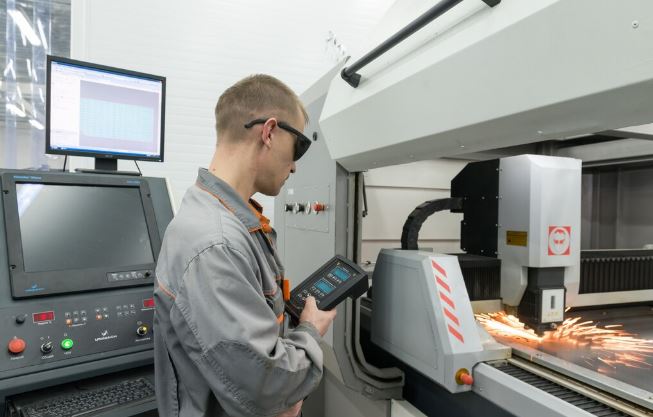
The machine itself usually commands all the attention when you walk into a modern laser clinic or industrial facility. It is sleek, hums softly, and emits that subtle clinical odor that seems to belong in medical settings. The person using it receives much less attention to their qualifications. what they truly understand. What they’ve been taught to do in the event of an issue. The difference between a skilled laser technician and an inexperienced one can be measured in burns, vision damage, and, in the worst situations, truly irreversible consequences. Hence, it is worthwhile to close that public awareness gap.
Over the past 20 years, laser technology has grown significantly, leaving hospital operating rooms and research facilities to enter clinics, beauty salons, and light manufacturing workshops. The expansion has brought about a change in accountability. Smaller private clinics and commercial workshops frequently rely almost entirely on the training and judgment of individual technicians. In contrast, hospital environments once had strong institutional oversight—biomedical engineers, safety committees, and accreditation bodies checking compliance. That’s a significant level of trust to put in someone the client doesn’t usually know.
| Detail | Information |
|---|---|
| Topic | Laser technician training, certification, and safety protocols |
| Laser Classifications | Class 1 through Class 4 (fiber lasers classified as industrial Class 4) |
| Primary Hazards | Eye damage, skin burns, respiratory risks, fire, electrical hazards, carcinogenic fumes |
| Key Safety Role | Laser Safety Officer (LSO) — responsible for all safety compliance |
| Training Types | Beginner intensive courses to week-long advanced industrial/medical programs |
| Governing Standards | ANSI Z136.3 (USA), IEC 60825 (International), OSHA regulations |
| Essential PPE | Wavelength-specific laser safety glasses, flame-resistant clothing, respirators, gloves |
| Maintenance Requirements | Daily cleaning, optical alignment checks, cooling system monitoring, blade/filter replacement |
| Ongoing Education | Refresher courses, conferences, workshops — mandatory as technology evolves |
| Complacency Warning | Identified by safety researchers as the single most dangerous hazard in laser operation |
| Reference | PubMed Central – Laser Safety: Risks, Hazards, and Control Measures (Smalley, 2011) |
Most people are unaware of how much the training itself varies. Basic laser physics, machine components, power-on and shutdown procedures, and an introduction to the software used to control beam parameters can all be covered in an intensive course lasting a few days for smaller, lower-powered systems. Training programs go much deeper and last up to a week for sophisticated industrial systems, such as fiber laser cutters, which are categorized as Class 4 lasers capable of causing immediate and permanent eye damage. Before they are even close to independent operation, trainees learn how to modify focal points, control pulse parameters, decipher the machine’s feedback, and troubleshoot issues under supervision. Driving a car and piloting a commercial aircraft are about as different as a novice using a small engraving laser and a technician using a powerful industrial or medical system. same broad category. entirely different degree of impact.
People who haven’t experienced it before will be surprised by the depth and specificity of the safety education woven throughout all of this training. Technicians learn to differentiate between procedural controls, which are human actions that prevent accidents when the machine’s built-in safeguards are ineffective, and engineering controls, which are safety features built into the machine by its manufacturer, such as interlocks that shut everything down if a protective door opens unexpectedly. Since the incorrect pair of safety glasses offers virtually no protection at all, they learn which protective eyewear is suitable for which laser wavelength. They learn where emergency stop buttons are located and how to use them, how to react in the event of a fire, how to deal with a beam deviation brought on by a contaminated or misaligned mirror, and how to handle the toxic smoke that is created when a laser cuts through specific materials, including fumes that may contain metal particles, chlorine compounds from PVC, and in certain situations, carcinogenic substances from materials like stainless steel that contains chromium.
When reading about laser safety, it’s difficult to ignore how much attention seasoned professionals give to one specific risk over all others. Not the beam itself. Not the electrical systems. complacency. On this point, the research is fairly consistent: the temptation to rush through a pre-operation checklist, assume everything is fine, or skip steps grows subtly as technicians become more familiar with a machine. A laser is only as safe as its operator, and the operator’s knowledge and discipline determine how well that safety actually holds, according to a frequently cited principle in the field. The machines themselves don’t grow weary or overconfident. The individuals in charge of them do.
One of the most important aspects of a technician’s job is probably routine maintenance, which is also the least obvious from the outside. The mirrors and lenses in laser machines’ optical systems, which focus and direct the beam, need to be routinely inspected for contamination and misalignment. In addition to decreasing cutting accuracy, a dirty lens can scatter the beam in ways that increase the risk of fire or expose operators to unexpected radiation. To keep the laser source from overheating, cooling systems must be monitored, filters must be cleaned, and distilled water levels must be checked. The cutting bed requires daily debris removal because accumulated particles and sparks on a surface that frequently gets extremely hot are, quite simply, a fire waiting for an opportunity.
Then there’s the issue of the Laser Safety Officer, or LSO, a position with significant formal responsibility that operates in most professional laser environments in a somewhat subdued manner. The LSO is responsible for evaluating risks, approving policies and procedures, making sure all employees have the necessary training and credentials, looking into any mishaps or near-misses, and acting as the point of contact for any inquiries from regulatory bodies or accreditation agencies. This is usually a designated professional with particular qualifications in larger healthcare or industrial settings. Sometimes the role falls to the doctor or business owner in smaller clinics or studios. This is feasible if they have truly engaged with the requirements of the role, but less feasible if they haven’t.
Training is a continuous process because technology is constantly evolving. Even seasoned technicians require frequent refresher courses and, ideally, attendance at industry conferences and workshops where they encounter challenges they have never encountered before due to new machine types, new clinical applications, new wavelengths, and updated international standards. A technician operating with knowledge that is several years out of date is operating with a gap they may not even be aware of, because the IEC and ANSI standards that govern laser safety in the majority of countries are updated on a regular basis. That gap is important. Probably unaware of its existence, the client lies motionless beneath the beam, trusting that the person operating the controls is an expert.
