

In a video, Bunnie Xo is seen sitting in a Beverly Hills clinic, gazing at an ultrasound screen that displays her own cheeks and uttering the words, seemingly in shock, “That’s a lot of filler.” It’s a brief moment. However, it does a better job than nearly anything else in recent memory of cutting through the typical glossy presentation of celebrity cosmetic procedures. For years, she had been dissolving fillers. She had visited several practitioners. And the substance was still there, visible on the scanner like sediment at a jar’s bottom, sitting beneath her skin.
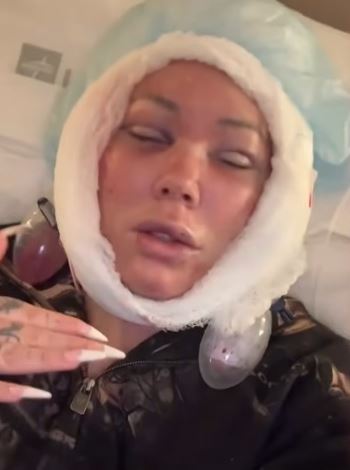
Millions of people saw that scene, which she posted on social media, and it became the focal point of one of the most openly honest stories about plastic surgery to come out of celebrity culture in a long time. On March 15, 2026, Beverly Hills-based board-certified plastic surgeon Dr. Daniel J. Gould performed a deep-plane facelift on Bunnie Xo, real name Alisa DeFord, the wife of Grammy-winning country rapper Jelly Roll. A mid-face lift, neck lift, brow lift, upper blepharoplasty, and filler removal with fat grafting were all part of the procedure. Since then, the transformation video has received more than 17 million views on Instagram and TikTok combined. The public’s hunger for this type of unfiltered documentation is demonstrated by that figure.
In a January episode of her Dumb Blonde Podcast, Bunnie revealed that she had been preparing for this choice for about three years. According to her, a red carpet photo that went viral online and showed one of her eyes partially closed was the turning point. She is open about the cause: years of dermal filler buildup in her upper eyelids, which resulted in swelling that prevented her from opening her eyes wide. Since her twenties, she had been receiving filler. Her ultrasound revealed a different picture even after several dissolution sessions. There was still filler. It had just become more firmly established.
The lack of spin in her approach sets it apart from the typical celebrity cosmetic surgery narrative. Before the surgery took place, she told her listeners on her podcast that she would look crazy and bruised and urged them not to panic. Then she carried out each awkward detail. Day one: surgical drains, compression wraps, and a face she said was hardly recognizable. Day five: patches of bruising are visible, there is still a lot of swelling, but the stitches have already come out. On the seventh day, she posted that she had lost all faith in humanity because the promised recovery had not yet turned around. That particular grievance, that type of timing, feels more like it was lived than controlled.
Speaking on his own Instagram, Dr. Gould defined the objective as a facial refresh rather than a drastic makeover. He emphasized that restraint and anatomical care, not aggression, are necessary when operating on younger patients who already appear attractive. The goal of the procedure was to address issues that had subtly accumulated over the course of two decades of cosmetic maintenance, such as the laxity in the neck, the heaviness in the mid-face, and the filler. As you hear them both explain it, you get the impression that this was more correction than conceit.
Bunnie has also been candid about her more extensive cosmetic history, including a rhinoplasty, gluteal fat grafting, and a breast augmentation that she later reversed after 13 years. She has stated unequivocally on record that she regrets some of the things she has done. She claims that the facelift does not fall into that category. She has stated that she wants to stop moving forward. No more filler, no more maintenance injections, and no more Botox, which she claims caused her eyes to become uneven anyhow. Just her current face, aging according to its own rules. That intention might be true. She might also go back to it when she’s fifty or fifty-five. However, there’s something noteworthy about the way she’s presented this as a break from a cycle rather than an extension of one.
It is important to reiterate the caution she gave her followers: filler can build up in tissue indefinitely and does not consistently dissolve, despite what practitioners claim. Delivered via a video of her own face on an ultrasound screen, that message was likely more impactful than any medical advice.
