

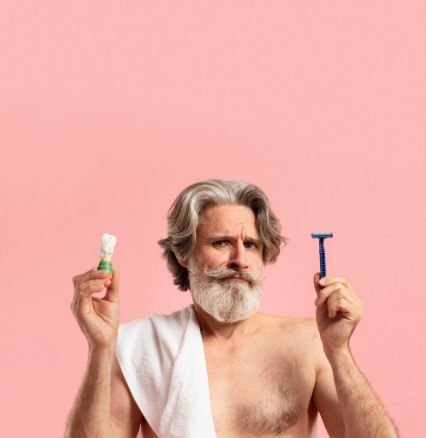
When you compare two men of similar ages in any office or barbershop, you’ll frequently notice something hard to describe but actually visible: the person who shaves every day has skin on his cheeks and jawline that is slightly thinner, possibly less resilient, and has fine lines that don’t exactly match what the forehead is doing. The forehead, which is usually left unshaven, frequently appears younger than the lower portion of the same face. This disparity is not imagined. It’s not inherited misfortune. It’s the culmination of what most men do each morning mindlessly.
Once explained, the mechanism is simple. Shaving is not a surface activity that is neutral. Every time a blade crosses the skin, it causes micro-trauma, which is tiny, imperceptible damage to the skin’s structure that, when added up over time, becomes significant. Inflammation is the body’s reaction to these wounds. The immune system creates a persistent, low-grade form of inflammation that goes unnoticed. The specific and well-established issue with persistent low-grade inflammation is that it prevents the synthesis of collagen. Skin’s firmness, elasticity, and capacity to recover from compression are all attributed to the protein collagen. The skin in that region gradually becomes thinner and less able to retain its structure when collagen synthesis is persistently inhibited by persistent inflammatory signals. Regularly shaved areas exhibit this effect differently than unshaven areas, such as the forehead and temples.
| Topic | Why Your Razor Could Be Aging You Faster Than You Think |
| The Core Mechanism | Daily shaving creates localized, chronic micro-trauma that triggers a persistent low-grade inflammatory response — over the years, this signals the body to slow collagen production, resulting in thinner, less resilient skin in shaved areas compared to non-shaved facial zones |
| Mechanical Wrinkles | Each razor pass creates micro-folding of the skin; young skin rebounds, but years of repeated mechanical stress cause these micro-folds to settle permanently — these “mechanical wrinkles” appear around the mouth and cheeks and are distinct from expression lines |
| Barrier Destruction | Shaving removes not just hair but the top layer of natural oils, dead cells, and beneficial bacteria — this “history layer” protects against environmental stressors and locks in moisture; frequent removal keeps skin in a constant “first-time exposure” state |
| Over-Exfoliation Effect | Daily shaving functions as daily physical exfoliation — strips the lipid barrier, leaving skin dull, scaly, tight, and more susceptible to UV damage; the skin loses its natural glow, one of the most visible indicators of youthfulness |
| The Neck Problem | Neck skin is thinner than facial skin, contains more nerve endings, and hair grows in multiple directions. Rushed, repetitive shaving strokes over this area cause invisible cumulative damage, resulting in earlier sagging, darker tone, and rougher texture than the face shows |
| Reference | Blue Nectar — Why Shaving Makes Certain Facial Areas Age Faster in Men (bluenectar.co.in) |
There is a mechanical component in addition to the inflammation. Every razor stroke physically compresses the skin’s surface under pressure and friction, a process known as “micro-folding,” according to some dermatologists. In the same way that memory foam regains its shape, younger skin quickly recovers from this. However, skin is not memory foam, and the ability to bounce back decreases with age and repetition. The folds don’t fully recover after enough years of daily microfolding in the same places. They agree. These are not the lines of expression that result from frowning or smiling; those are created by the movement of the muscles beneath the skin. Shaving-induced mechanical wrinkles appear on the surface, frequently around the mouth and cheeks, and, although they are not always obvious, they differ slightly from expression lines.
Additionally, the skin’s barrier is affected. Hair removal comes to mind when people consider shaving. However, a razor eliminates much more than just hair. The topmost layer of skin is removed with each pass, along with the natural oils, dead cells, and helpful bacteria that collectively make up the protective surface barrier. This barrier is more than just an aesthetic element. It serves as the skin’s first line of defense against UV rays, environmental harm, and moisture loss. The skin is left in a state of constant exposure when it is removed before it can rebuild, which is something that daily shaving never quite succeeds in doing. Dermatologically, it’s similar to daily exfoliation, which is not advised by any aesthetician because over-exfoliated skin behaves differently: it becomes dehydrated, loses its natural brightness, and is more susceptible to UV damage, which causes about 90% of visible skin aging.
Particular attention should be given to the neck since it often exhibits the earliest and most obvious effects of negligent shaving. Neck skin differs biologically from facial skin in that it is thinner, has more nerve endings, and has hair that grows in multiple directions at once. This means that shaving the neck usually requires several passes at different angles, is frequently completed quickly, and does not give the face the same attention. Here, invisible damage builds up more quickly than elsewhere, and over time, it manifests as an earlier sagging that makes the neck appear older than the face above it, a slightly darker tone, and a rougher texture. In a man’s forties, this disparity becomes increasingly difficult to overlook.
The equipment is much more important than most people realize. Every shave puts measurable stress on the blade edge because, when dry, beard hair is about as resistant as copper wire of the same thickness, according to scientific research on razor blade mechanics. After six or seven shaves without a replacement, a blade is dragging instead of cutting. A sharp blade and a dull one have quite different effects on the skin: drag increases friction, friction increases micro-trauma, and the compounding effect over years of using blades past their useful lifespan is real and cumulative. It is not a sign of vanity to replace blades every five to eight shaves. It is the most straightforward treatment for this specific type of slow-motion skin stress that is currently available. Anyone who has noticed increasing skin irritation or dullness in the areas they shave should take into consideration the trade-off of single-blade safety razors, which produce significantly less drag and heat than multi-blade cartridge systems and cause less surface disruption with each pass.
It’s difficult to ignore the fact that the anti-aging discourse almost entirely focuses on the products that people apply to their faces, with very little attention paid to the mechanical procedures they perform each morning. The retinol is added, the serum is bought, and the SPF is taken into account. For the twelfth shave in a row, the same dull four-blade cartridge is then dragged over the neck and cheeks. The daily habit is winning more consistently than anyone’s product routine is likely to make up for, and the two habits are working against each other.
