

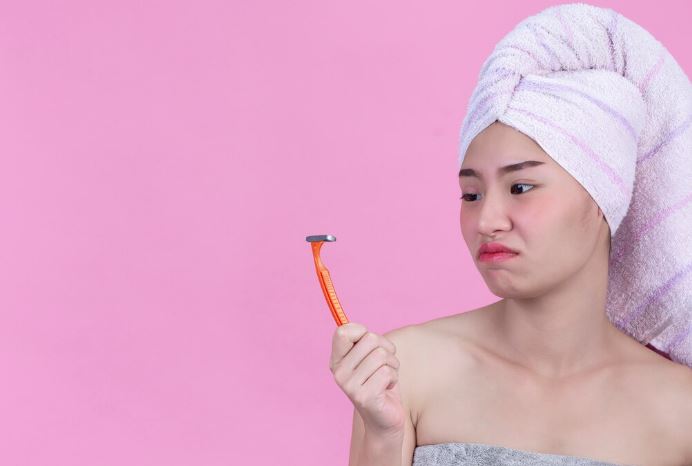
When I was thirteen, I was locked in my parents’ bathroom, the door wedged shut by a wicker hamper, and I shaved my arms for the first time. I was surprised by how heavy my father’s razor was. The hair floated in the sink water like a corpse after falling off in long, soft strips. The skin underneath seemed strange to me, almost too pink, like an animal that had lost its coat. I gave everything two rinses. I returned the razor to its original location. Then, for two weeks in May, I wore long sleeves to school in the hopes that someone would notice—not the shaving, but the shame that had driven me to do it.
There was a particular source of that shame. Why were brown girls so hairy? a boy in my eighth-grade class asked loudly enough for everyone to hear. He enumerated names. Twelve was his age. Twelve was my age. The teacher was the only one who remained silent, and the silence in the room seemed more weighty than the remark. By the end of the week, he might have forgotten about it. I never did.
| Subject | Personal essay on body hair, shame, and the cosmetic hair removal industry |
| Age first shaved arms | 13 |
| Age of first laser session | 30 |
| Years of habitual shaving | 17 |
| Areas treated | Legs, underarms, bikini, lower arms |
| Average industry cost (full body, multi-session) | USD $2,000 – $4,500 |
| Cited cultural source | South Asian and Mediterranean diaspora communities |
| Medical context | Sensitive skin, folliculitis, ingrown hairs |
| Body of related research | Beauty standards, gendered grooming, women, and self-image |
| Outcome at 30 | Sensitive skin, folliculitis, and ingrown hairs |
A lengthy, unimpressive accumulation ensued. The shower caddy has razors. Appointments for waxing are arranged around school pictures. The gradual transformation of funds that I could have used for books or bus fare into skin care, which would have been fine on its own. The math is subtly ridiculous, as anyone who has lived in the female-grooming economy will attest. The industry sells you the problem and then the solution, and once you’re in the cycle, it’s difficult to break free. This is why the laser industry is reportedly worth more than $1 billion.
When I finally entered the clinic at thirty, it was tidy, beige, and had a subtle antiseptic odor. The technician was courteous. She was carrying a clipboard. She pointed the gadget at my shin and asked if I wanted to include my arms in the package. I replied, “No.” Since that one covert afternoon when I was thirteen, I had never cared about my arm hair and had never even shaved it. After pausing, she told me, almost softly, that men disliked women with arm hair. She raised my wrist to the light. I foolishly mentioned that I was in a relationship. She said, “And he doesn’t mind?” with a look that still makes me think of one of surprise mixed with sympathy.
On the way home, I sobbed in the car. Not very loudly. When you realize you’ve been paying someone to make you feel horrible, you cry in an embarrassed manner. For the next three days, I looked at other women’s arms while waiting in line at the bank, grocery store, and subway to see if I was the only one. I wasn’t. However, once a remark like that takes root, it tends to stick, and I realized—with a clarity I didn’t have when I was thirteen—that this is precisely how the entire system operates.
Observing the online discourse change gives one the impression that something is becoming more relaxed. On TikTok, younger women share their unshaven legs without any introduction. Depending on the day, my friend, who works as a doctor, finds it either liberating or offensive that no one at work has noticed that she has completely stopped waxing. I have no idea where I will end up. I continue to attend my laser treatments. They are still paid for by me. The truth is that reading a well-written essay or seeing a self-assured stranger online doesn’t make seventeen years of conditioning go away.
I keep thinking about the thirteen-year-old with the heavy razor in the bathroom. She was not forced to do it by anyone. No one was required to. Long before she picked it up, the culture had already done the telling in a thousand tiny ways. The simple part is the laser. The ongoing task is to forgive her for believing them.
