

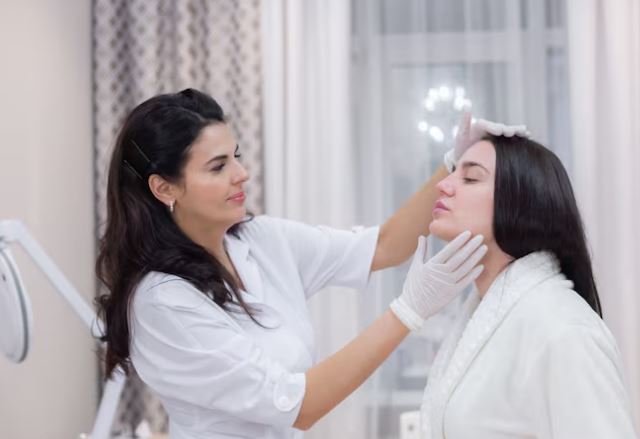
There was a subtle scent of something between clean laundry and cucumber in the room. In the corner, a tiny lamp hummed. After asking me to lie back, the esthetician—a composed woman with short nails and the slightly preoccupied demeanor of someone who has worked on a thousand faces—tilted the chair until the ceiling tiles became blurry. I realized I had been holding onto the armrests at that precise moment, before any gadget came into contact with my skin. Usually, strangers don’t get this close.
The HydraFacial is marketed as a glowing procedure. These days, the marketing is everywhere: the wand, the swirling serum, the assurance of immediate brightness. The strange intimacy of handing over your face for forty minutes is something that no one really discusses in the before-and-after reels. A small amount of surrender is required. You shut your eyes. The pressure, angle, and sequence of events are determined by someone else. It’s possible that receiving the kind of care that most of us don’t get is part of the appeal for a lot of people.
| Treatment Profile | Details |
|---|---|
| Treatment Name | HydraFacial (Hydradermabrasion) |
| Category | Non-invasive medical-grade facial |
| Core Process | Cleanse, exfoliate, extract, hydrate — one continuous pass |
| Typical Session Length | 30 to 50 minutes |
| Downtime | Essentially none |
| Patented Technology | Vortex-Fusion serum delivery with single-use tips |
| Recommended Frequency | Every 4 to 6 weeks for ongoing results |
| Suitability | Most skin types, including sensitive and reactive skin |
| Common Add-ons | LED light therapy, lymphatic drainage, targeted boosters |
| Professional Oversight | Performed by licensed estheticians or under a dermatologist’s supervision |
| First Launched | In the early 2000s, it gained mainstream popularity by the 2010s |
| Best For | Hydration, congestion, dullness, mild texture concerns |
Once you’ve experienced them, the mechanics themselves become almost tedious. As a cool tip moves over the skin, it simultaneously pushes in a thin layer of serum and vacuums out the contents of pores. A slight whirring sound is audible. It tugs a little around the nose and feels like a wet kiss from a machine along the jaw. No heat, no peeling sting, and no needles. The technology has been improved over time, and there is a discernible difference between this and a previous microdermabrasion session: it is more forgiving, gentler, and wetter. I continued to wait for the painful part. It never materialized.
The outcome was real, but it wasn’t the outcome that shocked me. By the time I sat up, my skin appeared as though it had slept for twelve hours and consumed a tall glass of water. The unexpected aspect was the speed at which trust develops and the ease with which it can be destroyed. The esthetician stopped midway through and muttered, “You have a little congestion along your nose, nothing serious, I’ll go slow.” A part of me relaxed. Most beauty appointments leave you with the impression that the person is acting competently rather than actually being competent. This was the reverse. She was not selling. She was merely at work.
The wellness industry has been subtly retraining people in this type of touch, and it’s difficult to ignore. Scrubs that burned, peels that flaked, and extractions that left you blotchy for a weekend were all part of the punitive script for years. Particularly sensitive skin learned to recoil. Dermatologic organizations like the American Academy of Dermatology have validated the shift toward gentler protocols, which feels more like a gradual correction than a marketing rebrand. It turns out that skin reacts to respect. Who knew? Well, probably estheticians. for many years.
There were still a few minor setbacks. The recovery area’s lighting was unflattering in a way that seemed almost intimate. The standard aftercare guidelines were provided on a printed card: no picking, no sweating for twenty-four hours, and no retinol for a few days. Don’t pick. By Wednesday, the majority of us will disregard this directive. The texture had truly changed, and I wanted to feel it, so I broke the rule and drove home, running my fingers along my cheekbone.
It’s more difficult to give a clear response on whether the glow persisted. By day three, the brightness had faded into something more subdued, more akin to the skin I tend to overlook. By the seventh day, my face had returned to normal, but I still felt as though I had been paying attention all week. Perhaps the most important lesson from a single HydraFacial is the brief reminder that skin is something you live with, not just something you struggle with, rather than the obvious change. Whether a single session is worth the cost for everyone is still up for debate. However, it was free to learn about touch and what it means to let someone be cautious around you.
