

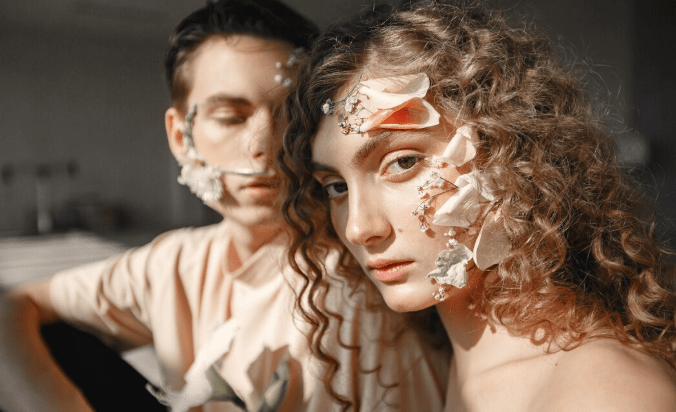
On a Saturday afternoon, observe who is in the skincare section of any Sephora. It won’t be the person you anticipate. Teens and young adults in their early twenties, some of whom are hardly old enough to drive, are carefully navigating shelves filled with vitamin C serums, niacinamide toners, and retinol formulas while paying close attention to ingredient lists. They have. They arrived at the store with a clear idea of what they wanted after watching hundreds of TikTok videos, following dermatologists on Instagram, and cross-referencing YouTube routines and Reddit threads. If you think back to earlier generations’ skincare regimens, which might have consisted of a bar of soap, a bottle of moisturizer, and the hazy knowledge that sunscreen was necessary, there’s something almost shocking about it.
It’s really hard to classify what Gen Z has done to the skincare sector. On the one hand, this generation’s level of awareness and seriousness about their skin is impressive, possibly unmatched for their age group. However, there’s a nagging question that’s worth considering: is some of this more related to anxiety than wellness? It appears that both are likely the answer, and the industry has done a great job of converting that uncertainty into profits.
Key Information
| Topic | Gen Z’s skincare obsession — trends, psychology, prejuvenation & industry impact |
| Generation defined | Gen Z — born approx. 1997–2012; first fully digital-native generation |
| Key trend | Prejuvenation — preventive anti-aging starting in early adulthood, before signs appear |
| Primary influence channel | TikTok, Instagram, YouTube — real-time beauty standards set and shared by influencers |
| Pandemic effect | “Zoom Boom” — videoconferencing increased self-scrutiny, driving aesthetic treatment demand |
| Popular treatments sought | Dermal fillers, laser rejuvenation, chemical peels, microdermabrasion, and medical-grade routines |
| Emerging expansion | Oral care is now part of the aesthetic routine — “smile glow-up” trend growing rapidly |
| Mental wellness link | Skincare framed as modern meditation — routine provides calm, control, and mindfulness |
| Ethical concern raised | Long-term effects of early aesthetic intervention: unrealistic social media beauty standards |
| Notable clinic cited | RefinedMD — early documenter of the prejuvenation trend; offers a full suite of preventive treatments |
| Reference / Source | RefinedMD — Prejuvenation & Gen Z Anti-Aging (Jan 2025) |
Prejuvenation, the practice of beginning preventive anti-aging treatments before any actual signs of aging have appeared, is what dermatologists and clinics are referring to as the defining shift. The strategy at RefinedMD, which started monitoring this trend in earnest around 2025, includes medical-grade skincare regimens, dermal fillers, and laser skin rejuvenation for patients who are frequently still in their early twenties. The reasoning is fairly simple: preserve what you have instead of making up for what you’ve lost. Prevention is preferable to correction. For many members of Generation Z, who are shaped by a proactive, research-first mindset that affects everything from their finances to their health, this kind of thinking, which would have seemed almost eccentric applied to skincare a generation ago, now reads as simply sensible.
All of this was accelerated in a particular and well-documented way by the pandemic. People spent hours staring at their own faces on screen when lockdowns forced daily life onto video calls. This wasn’t a fleeting glance in the mirror, but rather extended periods of time spent in unflattering lighting on grainy webcams that somehow managed to broadcast every perceived flaw. The increase was almost immediately observed by dermatologists and aesthetic clinics. The surge in consultations caused by the so-called Zoom boom hasn’t completely subsided. Gen Z, many of whom went through their formative years during that time, may have absorbed that scrutiny at a particularly impressionable age. It’s possible that staring at yourself on a screen for eighteen months has a lasting effect on how you think about your face.
Naturally, social media is the ecosystem that supports all of this. In addition to showing Gen Z what healthy skin looks like, TikTok and Instagram provide this information in a continuous, high-frequency stream through creators who have amassed sizable followings through their routines, before-and-afters, ingredient breakdowns, and aesthetic clinic adventures.
These influencers seem to have evolved into a sort of parallel dermatology that operates almost exclusively outside of the clinical setting and is approachable and relatable. Looking to TikTok for skincare advice seems completely natural to a generation that grew up viewing YouTube tutorials as instructional guides for everything from cooking to coding. It is another matter entirely whether it consistently results in wise choices. When nineteen-year-olds incorporate retinoids into their routines, dermatologists sometimes raise an eyebrow, pointing out that the skin at that age rarely needs what retinol is intended to address.
The aspect of mental health that has attached itself to all of this is intriguing and truly novel. For Gen Z and millennials, skincare has evolved into a kind of meditation, a daily ritual that offers structure, tactile engagement, and a few minutes of intentional self-attention in an otherwise hectic day, according to numerous wellness researchers and brands. Something is going on here. Cleaning, using a gua sha stone or a microcurrent device, and applying serums in the proper order all require presence. When your hands are on your face, your thoughts are not elsewhere. It’s worth considering whether the industry is deserving of praise for venturing into the realm of wellness or if it just became adept at disguising anxiety as self-care, but the impact on the individual appears to be significant enough.
Perhaps the most obvious indication that this is a generational perspective rather than a fad is the expansion into oral care. Target, Ulta, and Macy’s now carry brands like MySmile, which entered the market with teeth-whitening products meant to look good on a bathroom shelf alongside serums and mists. The “smile glow-up” is genuine. The logic of the skincare routine—invest early, maintain consistently, make it look good on camera—is being documented, hashtagged, and expanded to include teeth, lips, and probably whatever comes next. It’s difficult to ignore the fact that the generation most likely to be photographed also places a high value on appearing photogenic. It’s not a coincidence.
Depending on your belief about the true purpose of skincare, this could be either romanticization or revolution. Much of what Gen Z is doing—SPF, hydration, mild active ingredients, and expert consultations—is completely sound if the objective is healthy, functional skin. There are serious concerns about where wellness ends, and performance begins if the objective is the filter-smooth, softly lit complexion that receives thousands of Instagram likes. The truth is probably that most people in this generation are somewhere in the middle, truly taking care of their skin while also being influenced by a beauty ecosystem that makes money off of the differences between how their skin looks and how they would like it to.
