

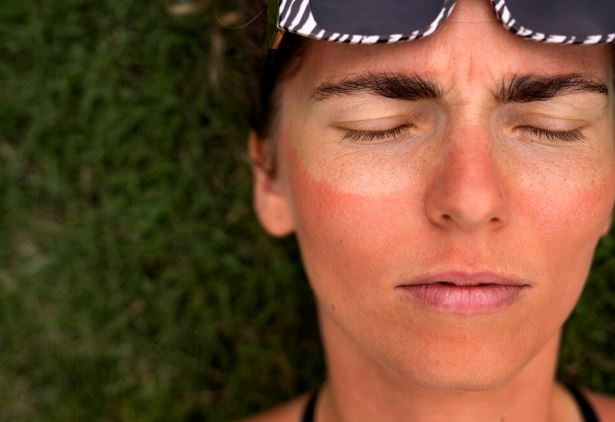
People underestimate them in part because they emerge gradually. The cheekbones appear clear one summer. A few years later, the bathroom mirror displays three brown patches on the left side of the face and two more that are spreading across the backs of the hands. These patches have a quiet permanence that wasn’t there before. After observing them, the majority of people conclude that they are an inevitable byproduct of spending time outside and move on. The dermatological community would like to discuss that logic.
Sun spots are patches of concentrated pigment that develop when years of UV exposure cause melanocytes to go into overdrive. Technically, they are solar lentigines, but no one refers to them that way in conversation. To create flat, darker areas on the face, hands, shoulders, and chest, the skin’s color-producing cells begin to group. The spots are harmless on their own. They don’t develop into melanoma. However, as dermatologists frequently point out, they are obvious signs of cumulative UV damage, the kind of damage that does raise the chance of developing skin cancer elsewhere over the course of a lifetime. In a limited sense, it is accurate to dismiss a sun spot as harmless. It is another matter entirely to treat the surrounding skin history as equally harmless.
Differentiating between a real sun spot and something that looks like one but isn’t is the more pressing clinical issue. People who examine their own skin may mistake actinic keratoses, which are rough, scaly patches brought on by UV damage, for age spots. Actinic keratoses are regarded as precancerous. A flat, pigmented lesion that looks nothing more unusual than a slightly dark freckle can be the first sign of early melanoma. Dermatologists teach the ABCDE framework, which includes asymmetry, irregular borders, multiple colors within a single lesion, diameter greater than six millimeters, and any change in size or color over a period of weeks. However, the framework is not without limitations. Before they become noticeable, some early cancers appear unremarkable. It’s the right order to have any new or changing spot professionally evaluated before committing to treatment; it’s not overcaution.
The available treatment options have significantly improved over the past ten years, assuming a correct diagnosis confirms the spots are benign. The most successful single treatment is still laser resurfacing, which uses concentrated light to target the melanin in the hyperpigmented area and kill the cells that produce pigment without coming into contact with the surrounding tissue. The fading lasts for several weeks following each treatment as the body removes the broken pigment, and results are usually seen over a number of sessions rather than in a single appointment. Cryotherapy is an alternative method that works well for isolated, well-defined lesions. It involves quickly freezing the area, which causes the darkened cells to blister and eventually shed. Sun damage is addressed more broadly by chemical peels and microdermabrasion, which remove the outer layers of damaged skin and promote a clearer, more even surface for regeneration underneath.
It’s difficult to ignore how many people attempt to treat sun spots with over-the-counter serums before consulting a professional; they frequently spend months using products that only slightly improve moderate-to-deep pigmentation. That’s not totally incorrect; retinoids actually speed up cell turnover and cause spots to gradually fade, and vitamin C and niacinamide can significantly reduce melanin transfer over time. Hydroquinone continues to be one of the most clinically effective topical bleaching agents available when prescribed by a dermatologist for brief cycles of three to six months. The problem is that at-home remedies are best used for prevention and maintenance rather than as the main treatment for darker lesions that have already developed. When used in the proper sequence—clinical treatment first, followed by topicals to maintain and safeguard the effects—the combination is far more effective than either one by itself.
Sun exposure that persists unchecked during or after the procedure is the factor that reverses a sizable portion of treatment progress. Melanocyte clustering was initially caused by UV radiation, and it will happen again with remarkable effectiveness. For anyone treating sun damage, a broad-spectrum SPF 30 or higher must be applied every morning, not just on days that are clearly sunny or right before an outdoor event. Physical barriers also matter: wearing UV-blocking sunglasses and a wide-brimmed hat on long days outside is not a fashionable option. Clinical maintenance is what they are.
In the skincare industry, sun spots are perceived as a cosmetic inevitability that should be covered up with foundation rather than treated at the root. The point is missed by that framing. The spots can be fixed. More importantly, whether or not treatment is sought, it is worthwhile to alter the behaviors that gave rise to them. The skin maintains a thorough log. While the editing options are still simple, it’s worth reading.
