

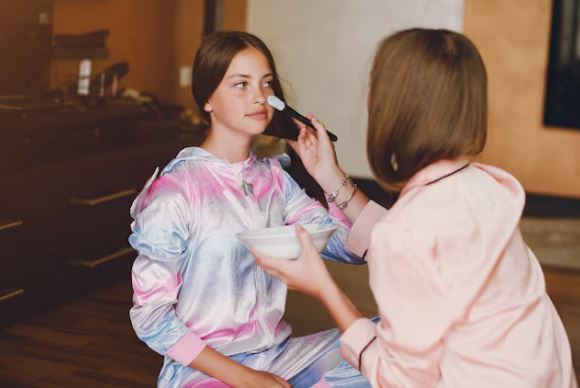
When you pass your teen’s bathroom and see the shelf, a certain kind of silent dread descends. The merchandise was arranged like a tiny lab. Brown dropper bottles containing serums. A toner with a clinical scent. Something called “retinol renewal.” The bathroom of a sixteen-year-old, which resembles the skincare section of a Sephora during a sale. It’s reasonable to wonder how this occurred and whether anyone should be concerned.
In the second section, the answer is most likely yes, at least somewhat. For the past few years, dermatologists who treat teenage patients have noticed a pattern: teens, primarily girls, showing up at clinics with irritated, damaged skin barriers brought on by overzealousness rather than neglect. Retinol, high-percentage glycolic acid, vitamin C concentrates, and firming peptides are the same products that power adult routines. When applied carefully to adult skin, these can be truly beneficial. They are more likely to cause chemical irritation, redness, and breakouts than to be beneficial on sixteen-year-old skin, which is still producing collagen and hyaluronic acid in amounts an adult would pay a high price to restore. These treatments are not necessary for the skin. Instead of fixing it, it needs to be protected.
Finding the trend’s origin is not too difficult. Because product recommenders on TikTok and Instagram are frequently peers or young adults rather than clearly identified professionals, skincare has become aspirational in a way that beauty magazines have never quite managed. Adolescents who witness a clear-skinned creator crediting a specific serum for their glow will interpret that as a personal testimonial rather than an advertisement. The line becomes hazy. Additionally, the companies aren’t hurrying to make it clear who their products are meant for. Dr. Justine Kluk, a consultant dermatologist and acne specialist with a clinic on Harley Street, has written candidly about witnessing her teenage patients arrive with adult-grade actives and eliminate entire food groups based on advice they found online. The false information is confident and pervasive.
The dialogue that a parent must have is not as dramatic as it may seem. It’s not a discussion about spending patterns or a dermatology lecture. It’s more akin to a mild diversion: going shopping for three or four necessities, examining labels, and creating something doable. It’s an almost embarrassingly easy routine. A gentle, fragrance-free cleanser for the morning and evening. A moisturizer that is lightweight and non-comedogenic. Use sunscreen every morning, ideally with an SPF of 50. That is the basis. Teens are not required to graduate from it until they are well into adulthood, and even then, only if there is a valid reason.
The discussion becomes more emotionally charged when it comes to acne, so it’s important to handle it carefully. Research consistently demonstrates that a teen’s degree of skin discomfort is not closely correlated with the severity of their acne. It’s hard to overstate from the outside how devastating a few persistent spots can feel at sixteen. Minimizing it is the worst thing a parent can do, and making the skin a frequent topic of discussion within the family is the second worst way to add another layer of self-consciousness. In a Sunday Times column, Dr. Kluk advised creating common ground by going shopping together, introducing the routine as something commonplace and useful, and keeping an eye on what they’re watching online without being overbearing. Pimple patches over picking and popping. If they choose to wear it, non-comedogenic makeup. Removal every night, without fail.
It’s important to be truthful about the place of expert assistance in this scenario. Over the course of several weeks, the majority of teenage acne responds to a basic routine that includes patience, a mild moisturizer, and a salicylic acid cleanser. This is not the case with cystic acne, which is located deep beneath the skin and is more prone to leave scars. If the emotional toll is substantial or if marks are developing, a dermatologist consultation is worthwhile, and a general practitioner can determine whether prescription treatment is appropriate. When all other options have failed, isotretinoin is available. Although it necessitates careful discussion, it has helped many teenagers who were truly having difficulties.
As a parent, this is something worthwhile to sit with. Telling teenagers that they don’t need the majority of its products is not something the skincare industry is very interested in doing. The adults in their lives are responsible for doing that, ideally before a fifteen-product routine has already caused harm. It’s difficult to ignore the fact that a better serum isn’t the most beneficial thing you can give your sixteen-year-old. Delivered at a time when she’s still likely to pay attention, it provides a clearer picture of what her skin truly needs.
