

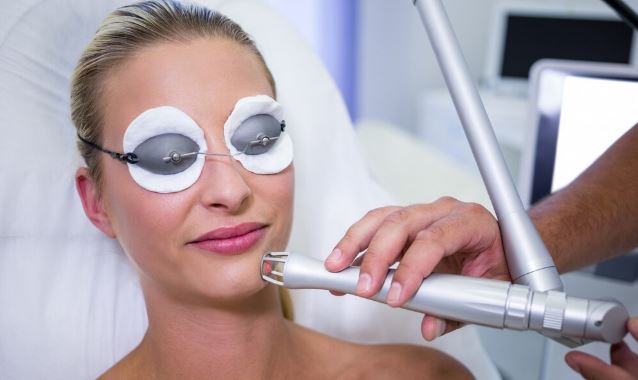
The anti-aging industry brings with it a certain kind of fatigue: too many promises, too many products, too many procedures that necessitate spending a week indoors while your face heals. Rejecting that formula completely has helped ClearLift laser treatment establish its reputation, at least in part. Do not peel. No days-long redness. No deliberate scheduling that takes social obligations into account. You enter during a lunch break, have a device cover your face for 20 to 30 minutes, and then you leave looking pretty much the same as when you came in, but subtly, something has started to change.
When you look past the marketing, the technology underlying ClearLift is actually fascinating. Utilizing a fractional Q-switched Nd: YAG laser operating at 1064 nm, it delivers incredibly brief, potent energy pulses, measured in nanoseconds, into the deeper dermal layers while completely sparing the epidermis, the skin’s outermost layer. This is the crucial difference that sets ClearLift apart from more antiquated ablative lasers like CO2 or conventional Erbium devices, which basically wound the skin’s surface to initiate healing. ClearLift skips that entirely. Without the recovery time required by ablative treatments, the thermal and acoustic energy directly reaches the dermis, initiating the production of collagen and elastin. It’s a cleaner mechanism, and the results, accumulating gradually over weeks and months as new collagen forms, tend to look more natural for it.
Perhaps the most well-known effect of the treatment is what it does around the eyes, a region that has traditionally been challenging to treat without surgery or injectables. Puffiness, dark circles, under-eye bags, and fine lines all respond to ClearLift because the laser’s stimulation of lymphatic drainage adds a practical component to the cosmetic one, improving skin quality and decreasing fluid retention. Dr Leah Clinics in London specifically position the treatment as a non-surgical eye rejuvenation option, sometimes combining it with tear trough dermal filler for more comprehensive results. That combination approach, pairing ClearLift with other modalities, has become common in aesthetic medicine more broadly — clinics frequently stack it with chemical peels, microdermabrasion, or Fraxel to address different skin depths simultaneously.
It’s difficult to ignore how closely ClearLift’s growth corresponds with a more general change in the culture surrounding cosmetic procedures. The appetite for procedures that look like nothing happened — where the point is gradual, natural-looking improvement rather than an obvious before-and-after — has grown steadily over the last decade. ClearLift nearly perfectly satisfies that need. Results after the first session are often subtle. The improvement in texture, firmness, and tone tends to be more noticeable after a full course of four to six treatments spaced about a month apart, but it reads more like someone taking better care of themselves than something specific.
Is the payoff commensurate with the cost? This is a legitimate question worth considering. The cost of the entire course adds up, with sessions ranging from £350 in UK clinics to $600 in some US locations. Sessions must be held every six months or so indefinitely to sustain the real but gradual results. ClearLift may seem unimpressive to patients who are hoping for the kind of significant improvement that aggressive resurfacing or surgery can provide. However, ClearLift might be just the right amount of treatment, neither more nor less, for people dealing with early-to-moderate signs of aging, working lives that don’t allow for recovery time, or skin that’s just too sensitive for harsher options.
