

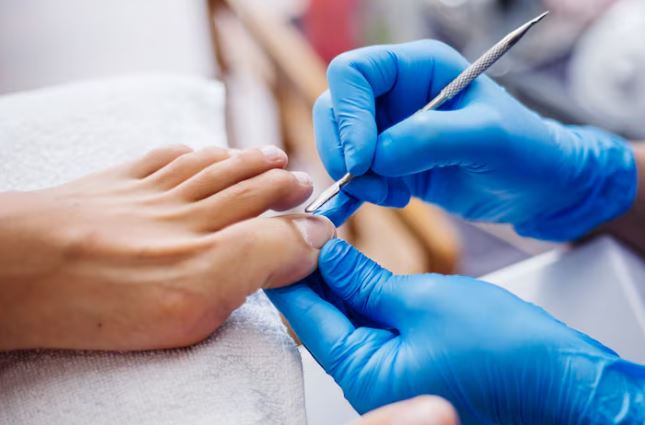
These days, most podiatry clinics have a before-and-after photo board somewhere near the reception desk, most likely next to a laminated diagram of foot anatomy. The thick, yellowed, and occasionally greenish-edged nails in the “before” column are the kind that people have been covertly concealing in socks for years. The “after” pictures reveal a completely different image. Clear, normal-looking nails that are growing. Laser treatment is increasingly used to join the two columns.
Fungal nail infection — onychomycosis, in the medical vocabulary — is one of those conditions that sits in a strange space between the cosmetic and the clinical. It isn’t life-threatening. But it has a way of quietly shrinking someone’s life. Open-toed shoes become unthinkable. Communal changing rooms become something to be strategically avoided. Research from Brown University Health notes that roughly half of all Americans will have been affected by toenail fungus by the age of 70, a statistic that sounds improbable until you spend ten minutes reading through the patient forums where people describe years of failed creams and embarrassed avoidance.
The traditional treatments have never been especially satisfying. With efficacy rates that typically range from 10 to 45 percent, topical antifungal lacquers find it difficult to penetrate the nail plate deeply enough to reach the fungus that lives beneath it. The effectiveness of oral antifungal drugs is more consistent, ranging from 50 to 76 percent. Still, there is a catch: the drugs are processed through the liver, necessitating continuous blood work and posing serious risks for individuals with pre-existing conditions. That’s a big trade-off for a non-dangerous condition, and perhaps this is precisely why laser therapy has found such a receptive audience.
The fundamental mechanism is not as complicated as it may seem. A focused light beam, such as a thermal or low-level cold laser, is aimed at the infected nail and passes through the nail plate to the fungal cells beneath. Thermal lasers can kill fungal cells without harming the surrounding skin by heating the tissue to between 45 and 50 degrees Celsius. A completely different strategy is used by cold laser systems, such as the Lunula device, which use two concurrent low-power beams, one to weaken the fungal structure and another to increase local blood flow and immune activity. Patients who have heard about “mild sensation” and imagined something much worse seem to care a lot about the Lunula variation’s complete lack of pain.
It’s difficult to ignore the patience needed for the treatment. The laser destroys the fungus during the session itself, but the nail doesn’t immediately look different. Toenails grow slowly — roughly 0.03 to 0.05 millimetres per day — meaning healthy nail replacing the damaged area takes twelve to eighteen months to become visibly obvious. Because it would be challenging to monitor progress in real time otherwise, clinics take precise pictures of nails at every appointment. That timeline asks something of patients accustomed to expecting visible results quickly, and there’s a small but genuine risk of reinfection during those months if aftercare isn’t followed carefully. Shoes need antifungal treatment, socks need to be washed at 60 degrees, and communal swimming pools require sandals.
Still, clinical clearance rates ranging from 79 to 97 percent for cold laser — and 60 percent or above across laser types generally — represent a meaningful step forward from what was available before. Watching the technology settle into mainstream podiatry practice, you get the sense that laser treatment isn’t trying to be dramatic. It’s merely making an effort. And that quiet competence is probably sufficient for a condition that has spent decades withstanding everything else thrown at it.
