

When you reach your 40s, a certain type of frustration sets in. Not the philosophical, abstract kind, but the kind that appears on your face. In actuality. Every time the bathroom light catches them at the wrong angle, dark patches that you can’t quite recall earning appear along your cheekbones or close to your temples, becoming slightly more noticeable. The odd thing is that the majority of them weren’t brand-new.
Dermatologists have a pretty good explanation for the situation. When you’re in your teens and twenties, sun exposure doesn’t always show up right away.
While your younger cells regenerate fast enough to maintain a relatively uniform appearance, the UV damage is quietly and patiently embedded in the lower layers of your skin. Then, as most people reach their mid-to-late 30s, collagen production starts to slow down, and that natural cellular renewal takes place. The areas that have always existed begin to show. Many people might think they’ve developed new pigmentation issues when, in reality, they’re just seeing the delayed bill for twenty years of sun exposure.
It’s not a dramatic reveal, but rather a slow one. The patch next to your eye appears faded after a month. It doesn’t after six months. You never wake up in the morning and find that everything has changed. Like most skin changes, it creeps.
When someone in their 40s considers treating hyperpigmentation, the topic of lasers frequently comes up. Newer picosecond devices, such as the PicoSure Pro and PicoWay, which function by shattering pigment particles beneath the surface rather than burning across the top of the skin, are more effective than the older, more aggressive resurfacing technology that required a week of true hiding-from-the-world recovery.
Precision is the concept. The concentrated melanin is located by the laser, which then breaks it up into pieces that the body can process normally.
For the majority of people, the experience is far less dramatic than the technology suggests. Usually, sessions last between 20 and 30 minutes. Some have compared the snapping sensation to a rubber band flicked against the skin. In the days that follow, the spots become noticeably darker before they improve, which is counterintuitive. This is how the process operates.
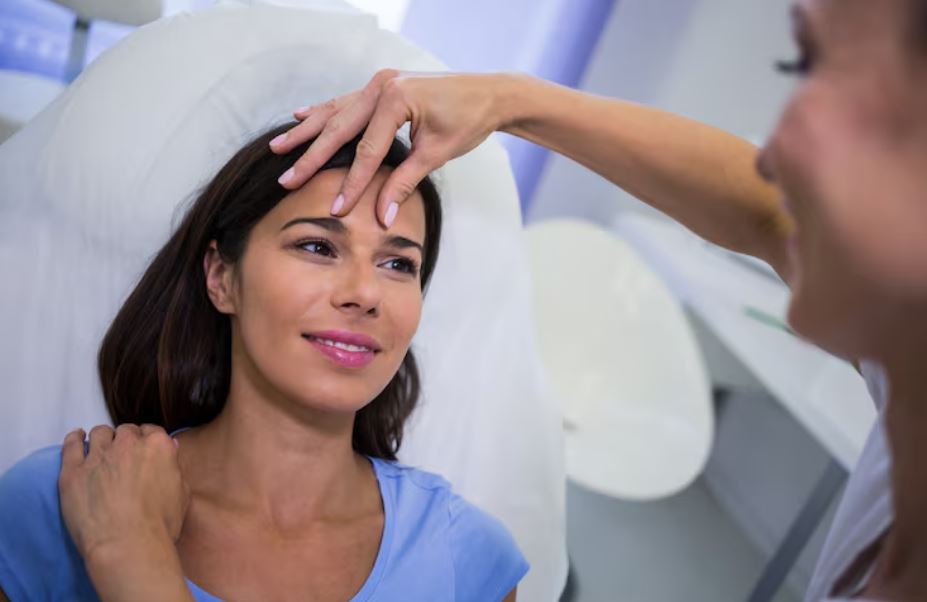
Over the course of the next week, the targeted pigment naturally sheds after rising and forming what appear to be tiny dark flecks on the surface. There is cleared skin underneath. Given how frequently it’s reported, it’s still unclear why so many people are surprised by this apparent worsening before improvement.
Seldom do results show up after just one session. The full improvement frequently continues to develop for several weeks after the last appointment, and most practitioners advise two to four treatments spaced roughly a month to six weeks apart. Before beginning, it is probably reasonable to acknowledge that this timeline requires some patience from those who anticipate instant transformation.
What follows is easier to ignore and often receives far less attention than the treatment itself. Mature skin has a lower threshold for UV-triggered pigmentation than it did twenty years ago. This is just the reality of skin in your 40s and beyond. In your 20s, sun exposure might have faded on its own, but now it can redeposit pigment much more stubbornly. Every day, SPF 50 is not additional advice. It is what establishes the investment’s viability.
Considering all of this, one gets the impression that the skin damage that most people sustain in their twenties wasn’t actually invisible; it had just not yet become apparent. It can actually be addressed by the lasers that are currently on the market. Perhaps the most important lesson to be learned from all of this is that the discussion about sun protection should have taken place much earlier.
