

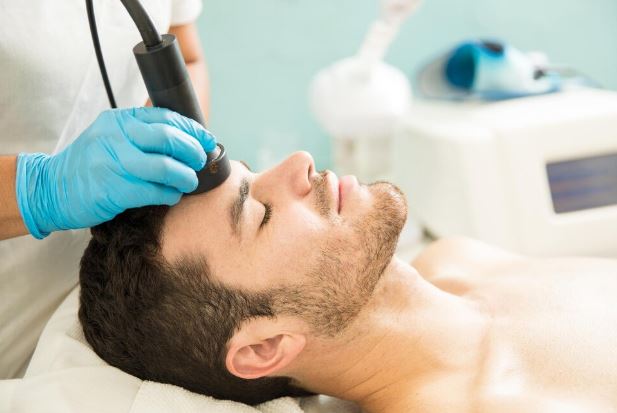
There’s a good chance you’ll find a man in the treatment chair if you walk into practically any aesthetic clinic in a big city on a Tuesday afternoon. Not a famous person with a publicist on call all the time. Just an ordinary man in his late thirties, a sales director or project manager, in for thirty-five minutes before returning to the office with his shoes still on. Most likely, he hasn’t told anyone at work about this. He might not even bring it up.
The popularity of HydraFacials among men is one of those cultural changes that start subtly and then all of a sudden become apparent. Clinics that used to serve almost exclusively women are reporting a steady increase in male bookings, which is motivated more by practical considerations than by vanity. Men’s skin is structurally different, with larger pores, a tendency to produce more oil, and daily abrasions from shaving. With its Vortex-Fusion technology, which simultaneously clears pores, exfoliates dead cells, and infuses skin with hydrating serums, the HydraFacial takes care of all of that in a single session and leaves no trace. No redness. No peeling. There is no window for recovery. You could plan one for noon and attend a client meeting by two.
Perhaps the silence surrounding it speaks louder than the actual treatment. Many men still feel uncomfortable with anything that comes under the skincare category because they believe that taking care of your face still needs to be justified in some way, framed as efficiency rather than care. As a result, it is referred to as “sorting out the dry patches” or “dealing with the blackheads,” which are pragmatic terms for a useful treatment. The result is the same. Simply put, the framing makes it simpler to make reservations without hesitation. Dermatologists who treat male patients on a regular basis often observe that men specifically come in because they want results with the least amount of fuss.
The product itself has changed. In many respects, the HydraFacial is specifically made for this kind of low-commitment, high-return strategy. There isn’t a complicated aftercare plan or a seventeen-step instruction manual. You leave after the treatment does the heavy lifting in the chair. That simplicity eliminates most of the hesitancy for men who have never had a facial of any kind. A forty-minute clinical treatment starts to make sense when the alternative is to keep using a three-in-one shower gel on your face and wondering why your skin appears dull by Thursday.
Notably, the market for men’s grooming as a whole has been moving in this direction for a while. Over the past ten years, the global industry has grown significantly, with skincare in particular surpassing more established categories like shaving products. Companies that used to market moisturizer to men under pretenses, such as “face balm” or “post-shave hydration,” have quietly stopped doing so, and customers have followed. As they frequently do, celebrities contributed to its normalization. Athletes like David Beckham creating skincare lines, Pete Davidson openly discussing his skin treatments—the cultural landscape changed, and treatment room reservations followed.
Observing all of this gives me the impression that the stigma is becoming irrelevant rather than drastically going away. The men who schedule HydraFacials don’t stand out. They’re not making any posts about it. They simply do it, then go about their day with noticeably cleaner skin and no desire to justify themselves. Which is, in a sense, the most self-assured skincare method. Their skin responds well to the treatment. They can fit the thirty minutes into their schedule. Even if they aren’t telling their partners, that is the entire story.
