

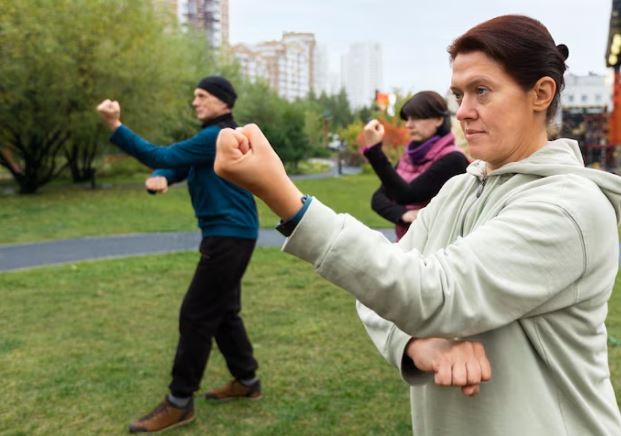
The majority of people have taken tens of thousands of steps without ever giving them much thought. Generally speaking, walking is meant to be automatic, unconscious, and a background function that the body performs while the mind is elsewhere. Walking Tai Chi asks you to reverse all of that. Every action becomes purposeful. Every weight shift is considered. And somewhere in that slowness, something genuinely interesting happens.
At its core, Tai Chi walking applies the foundational principles of traditional Tai Chi — a Chinese martial art with roots stretching back to the Ming-Qing dynastic transition — to the simple act of moving forward. It is not “walking slowly for no reason.” It is a structured weight-transfer practice that trains balance, posture, coordination, and attention. The key distinction from ordinary walking is almost philosophical: rather than relying on forward momentum to carry you from one foot to the other, you shift your full weight entirely onto one leg before the other foot leaves the ground. The empty leg, as Tai Chi tradition calls it, floats forward and places the heel down gently before any weight follows. It sounds simple. It is not.
Slow, deliberate movements paired with controlled breathing help practitioners improve balance, posture, and coordination in ways that ordinary walking — no matter how many steps you log — simply cannot replicate. There’s a reason traditional Tai Chi masters required students to practice walking drills for months before teaching them any form sequences. The felt sense of where your body is in space and the trained ability to correct imbalance before it becomes a fall are two things that the stepping patterns develop and cannot be rushed.
The health evidence is convincing, even though it still focuses on Tai Chi walking as a stand-alone practice. Numerous systematic reviews and clinical guidelines have linked Tai Chi to enhanced balance performance and decreased fall risk in older adults. For older populations especially — and for anyone managing knee discomfort, ankle instability, or the kind of low-grade joint pain that accumulates quietly over decades — the practice offers something most conventional exercise programs don’t: a way to strengthen the stabilising muscles around vulnerable joints without loading them aggressively. Additionally, studies have shown improvements in sleep quality, lower limb strength, and aerobic capacity in individuals with lower baseline fitness. These aren’t marginal findings.
There’s also something harder to quantify but not hard to notice. The act of focusing entirely on physical movement, such as the heel making contact with the ground, the slow roll through the arch, or the gradual transfer of weight into the front leg, draws attention away from the daily cacophony and places it in the present moment. It functions, in a genuine and not merely metaphorical sense, as moving meditation. The nervous system calms. According to some studies on Tai Chi in general, cortisol levels tend to decrease with consistent practice. Some Tai Chi practitioners claim that walking for ten minutes calms them down more than running for thirty minutes. Rather than brushing that off, it’s a claim worth considering.
Getting started requires almost no preparation. With your knees soft and not locked, stand with your feet hip-width apart. When you fully shift your weight onto one leg, it becomes “empty,” which means you should be able to lift it without making any adjustments. Bring that empty foot forward, drop your heel first, roll through to your toes, and then deliberately move your weight forward into your front leg. The pace is slow enough that, especially outside, self-consciousness may set in right away. It’s worth overcoming that discomfort. For beginners, consistency matters far more than duration — five to fifteen minutes a day is enough to see genuine benefits accumulate over time.
It’s still unclear if Tai Chi walking will ever completely overcome the stereotype that it’s only appropriate for senior citizens in parks. That perception undersells it considerably. There’s genuine depth here — layers of technique and awareness that take years to develop properly, if that’s the direction someone wants to go. However, even at the surface level, when done carelessly and imperfectly, it imparts something that most contemporary movement routines completely ignore: the guidance to slow down, pay attention, and approach walking as an act deserving of consideration. That alone, in a time when everything wants to be faster, feels quietly radical.
