

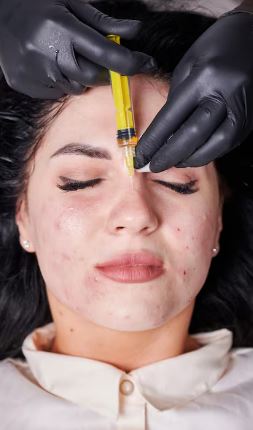
Acne scars are associated with a specific type of defeat. The breakouts themselves are one thing: annoying, erratic, and ultimately controllable. However, their imprints are entirely different. Regardless of the serums applied on top of them, they remain stationary on the cheekbones and jawline, silently defying every promise made by every skincare company that has ever advertised. Many people subtly come to believe that the skin they have after acne is just the skin they are retaining.
When you first encounter microneedling, it challenges that assumption in a way that seems almost counterintuitive. The fundamental idea—that purposefully puncturing the skin with hundreds of tiny punctures will somehow improve it—seems like a dare. However, the process is sound and based on the same principles as wound healing: when tissue is damaged in a controlled manner, the body reacts by sending fibroblasts to the site, where they produce new collagen and elastin to fix the damage. There is no one dramatic moment that makes the scars go away. As the remodeling process progresses, they gradually disappear over several months, filling in from below.
The most doubt is usually generated during the first session. Applying numbing cream about 45 minutes in advance helps a lot, but the redness that follows is real; the skin appears sunburned for several days, tight, and slightly swollen, especially under the eyes. The period of time between the procedure and the revelation calls for some patience, but most people return to their routines within a week. Skepticism usually peaks during that waiting period. Beneath all that annoyance, there’s a feeling that nothing could be going on.
But something is. According to clinical research, a full course of three to six sessions results in a fifty to seventy percent improvement in the visibility of acne scars. This number may seem promising until you compare the before and after photos. As the underlying tissue rebuilds, the boxcar scars and rolling depressions that characterize post-acne skin gradually react to the collagen induction process, becoming shallower over the course of several sessions. Individual factors, such as skin tone, scar depth, and the degree to which aftercare is adhered to, may have a significant impact on the outcome, and the results may differ more than the promotional literature indicates. However, the pattern is generally the same: each session builds upon the previous one.
Due in part to social media documentation and in part to the growing availability of professional-grade devices outside of dermatologist offices, the discourse surrounding microneedling has expanded significantly in recent years. There should be some caution in that final section. Although many people use at-home rollers, a clinical device’s needle depth and sterility requirements differ from those of a consumer product purchased online. Deeper needle penetration is necessary for atrophic scarring, and doing it incorrectly either underperforms or increases the risk of infection. A fixed-depth home device cannot duplicate the way a certified practitioner modifies the settings according to the particular issue being addressed.
Microneedling in conjunction with platelet-rich plasma (PRP), which is extracted from the patient’s own blood and applied to the skin during treatment, is one variation that is worth comprehending. The benefit is said to be an acceleration of the collagen response that standard microneedling starts, but it sounds more dramatic than it actually is. It’s difficult to ignore how quickly this combination has spread from specialty clinics into more general practice; five years ago, it was a relatively unknown add-on, but now most respectable medical spas offer it on their menus. The research community is still unsure if the PRP actually improves outcomes or serves more as a premium upsell.
The outcome is more influenced by aftercare than most people anticipate before entering. Genuine self-control is needed during the first 24 to 48 hours; avoid using makeup, active skincare products, or anything that could contaminate skin that has just been purposefully punctured thousands of times. Dermatologists frequently point out that the primary cause of hyperpigmentation, especially in darker skin tones, is sun exposure during the healing window. It’s not as optional as it might seem to wear a broad-spectrum SPF consistently throughout the course of treatment.
The maintenance reality that follows a finished course often takes people by surprise. In contrast to the monthly cycle of waxing appointments or the daily routine of layering treatments that don’t actually reach the dermis, one or two sessions per year is usually sufficient to maintain the results. This workload feels almost absurdly light. The skin appears to retain its gains longer than most topical treatments permit because it has been repeatedly encouraged to rebuild. It’s not really about glowing skin in the promotional sense, despite the filter-on-your-face comparison that appears in almost all personal accounts of microneedling. It has to do with skin that appears to be functioning normally once more.
